In January 2020, I was accepted into Stureakademin, the think tank Timbro's advanced program in political ideology. During the same period, I studied medicine at Uppsala University. The media reported on a virus spreading in central China. As a medical student, my classmates at Kungsgatan 60 asked me how best to deal with the disease. I remember being shown a graph of the number of cases in the city of Wuhan. “It's not exactly something to get excited about,” I remember replying. I was convinced that the infection would remain a local problem, similar to the outbreaks of SARS and MERS, which were also caused by coronaviruses. Of course, I had to eat my words. A few months later, Timbro put the training program on hold because the Public Health Agency had restricted gatherings.
Shortly thereafter, I began an internship at Uppsala University Hospital. My supervisor was a man in his fifties. On my first day, he showed me around the clinic. Like many of my colleagues, he was hyperstimulated by coffee and white snus, and therefore walked very quickly. I had difficulty keeping up. Soon everything would change, the man said. The entire operation would be converted to Covid-19 care. He then explained that this pandemic would be the worst the world had ever seen. When he was done, he turned around and looked me in the eye. “But remember,” he said. “The worst infection of all is neoliberalism.”
It is one thing to believe that capitalism is bad. However, describing a certain political conviction as “contagious” when meeting a younger colleague for the first time says more than what you personally think about it. It should be noted that my supervisor was not unpleasant at all. He was a good doctor, and in the weeks that followed, I also realized that he was an unusually empathetic person. The reason he expressed himself so drastically was, I believe, because he could never have imagined that I had any sympathy for neoliberalism. He probably considered the ideology to be as obviously wrong as Nazism. For me, that statement has come to symbolize the medical profession's sometimes bizarre hostility toward the market economy.
It is no coincidence that these views are so widespread. In Sweden, as in many other countries, healthcare is a planned economy. This fact permeates every layer of its institutional culture. Even during our training, we encounter numerous examples of how large-scale planning has succeeded in solving public health problems. These may involve
examples include the general vaccination program or mammography screening for breast cancer. It is, of course, true that these measures have had good results. But the programs have been successful despite the planned economy, not because of it. In addition, the involvement of the business community has been much greater than some would like to claim. The obvious fact—that both vaccines and X-ray machines are manufactured by profit-driven companies—is mentioned in passing or omitted altogether. Those who begin their medical studies in their early twenties therefore get the impression that no problem is too big to be solved through central planning.
In reality, a planned economy leads to numerous problems. When bread production is planned centrally, bread queues arise. When healthcare is planned according to the same principles, healthcare queues arise. Indeed, healthcare today is rationed. Despite this, the cost has risen every year, not only as a result of our increased wealth, but as a percentage of GDP. From around 5 percent in the 1970s, it is now just under 12 percent.
It is important to understand that these queues can also arise in the midst of abundance. In the Soviet Union, over 80,000 pairs of shoes were produced per day during a certain period. Nevertheless, people had to queue for days when their boots wore out. This was because the shoes that were produced were uncomfortable. Therefore, people chose to wait their turn when stores offered products they really wanted, most of which were imported from market economies such as the US and West Germany.
Similarly, certain areas of healthcare currently have extremely long waiting lists, while others have low demand and consequently good availability. To say that “healthcare is understaffed” is therefore far too sweeping a statement. At the same time, there is currently a large influx of people turning to privately funded alternatives, even though their customers have already paid for public healthcare through their tax bills.
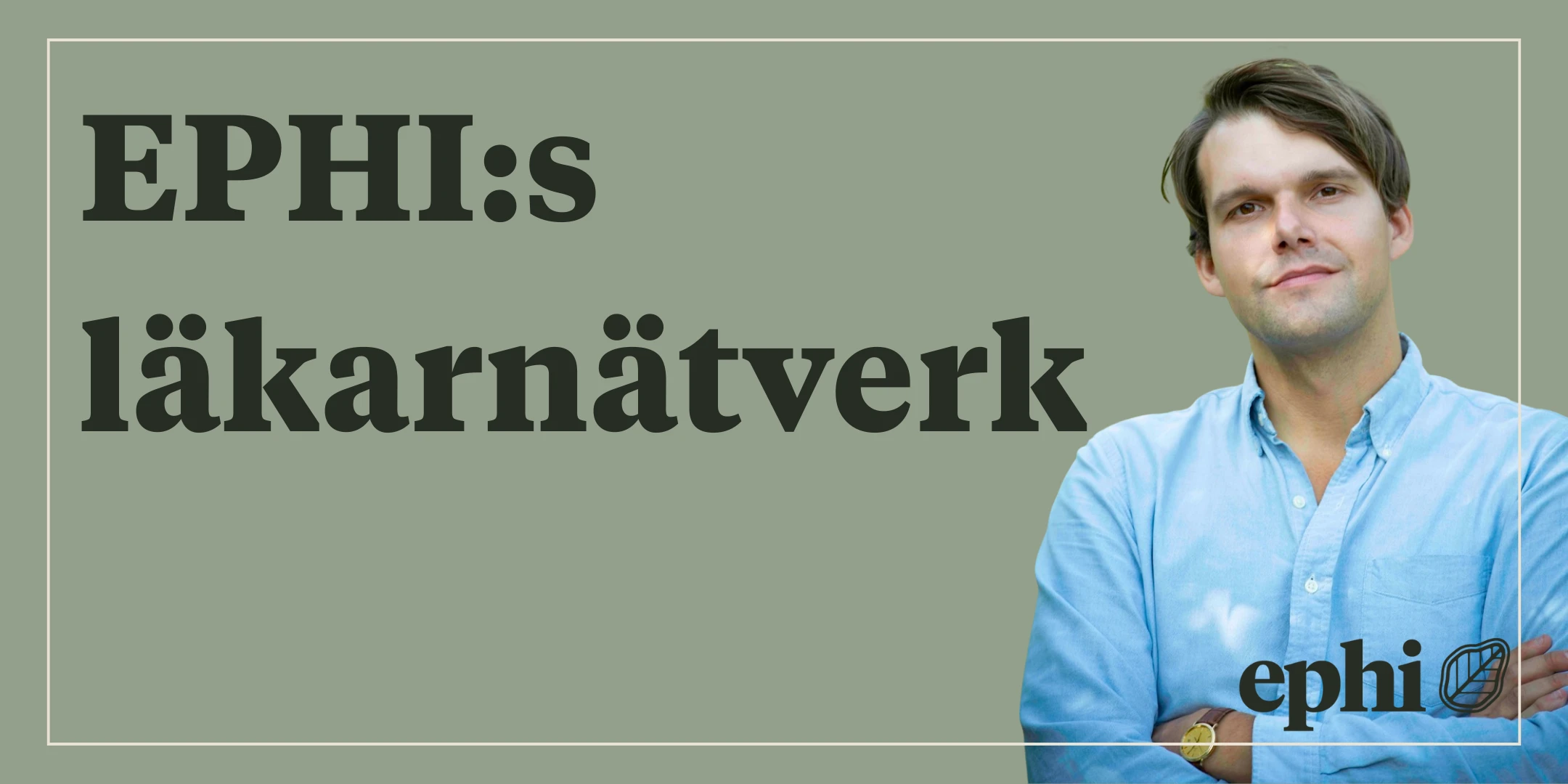
These simple insights—that a significant portion of healthcare problems stem from the fact that it is run as a planned economy—are strangely poorly regarded among the medical profession. Instead, many seem to believe that the solution is more money and stricter rationing. As a result, we have now founded the EPHI think tank's physician network. In the future, we hope to be able to work towards better, freer, and more accessible healthcare for the whole of Sweden.
Vincent Amble-Naess,
Doctor and head of the medical network

EPHI's network of doctors will respond to referrals from the Council on Legislation, write opinion pieces, and organize joint study visits.
Are you a doctor interested in joining the network? Please contact vincent.amble-naess@ephi.se