
China and the climate after COP26

China and the climate after COP26

This Briefing Paper maps China's greenhouse gas emissions and the country's role in climate change, and reviews the Chinese authorities' climate ambitions and action plan to achieve carbon neutrality.

China's emissions are the single most important factor for the future of the climate. It currently emits more carbon dioxide than the EU and all other OECD countries combined. Unlike other leading economies, Chinese emissions increased even during the pandemic and are expected to continue to rise until 2030, according to the authorities' official climate policy.

Dependence on coal is the main source of these emissions. To be sure, China has recently pledged to stop financing coal power abroad and is investing heavily in green energy. But at the same time, it is expanding its own coal power, even though it already burns more than half of the world's coal. Furthermore, domestic factors rather than exports to Western consumer societies are behind China's huge emissions.

Like many other countries, China intends to become carbon neutral. However, the question is whether Beijing's timetable for this is realistic, as emissions will grow for many years to come.

Despite the fact that developments in China are absolutely crucial to climate change, Beijing's actions are given little space in the Swedish climate policy debate. Even less does this fateful issue appear in Sweden's climate policy, which is both a rejection of our own approach and a threat to the climate.

If you don't have a China strategy, you cannot be said to have a climate strategy.

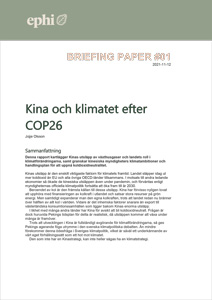
Briefing paper #1 China and the climate after COP26 - Jojje Olsson (pdf)
Author talk with Jojje Olsson

Contact us

Environment and Public Health Institute


Box 3039,
103 63 Stockholm

info@ephi.se

Org. number: 559342-4947

Latest from ephi.se on TT

Podcast: Health for the unhealthy

202. The conflict code

Is conflict something we should avoid - or take more seriously? In this episode, we meet Hana Jamali, psychologist and author of the book The Conflict Code, who argues that conflict is a vital part of close relationships. We talk about different styles of conflict...

read more

201. Abolishing the tax credit - at what cost?

The Social Democrats are campaigning to abolish the deduction for sick leave - a decision that could have serious consequences for the Swedish economy, according to Christian Ekström, CEO of the Taxpayers' Association. Why does sickness absence seem to increase during the Winter Olympics, moose hunting and the World Cup?.

read more

200. How endometriosis is treated

Endometriosis affects many people, but remains one of our most misunderstood diseases. In this episode, we explore the causes, symptoms and treatment with Ingrid Sääv, gynecologist and medical director of Stockholm's youth clinics.

read more

198 Ineffective prevention

The prevention currently practiced in Swedish healthcare is not effective. This is the opinion of specialist physician and researcher Minna Johansson, who has recently written a report on the subject. Based on the report, she discusses how overdiagnosis and demands for counseling...

read more

197. More generalists in healthcare

Swedish healthcare is characterized by an increasing number of specialists who focus on their own narrow area, while fewer and fewer look at the whole patient. This is the opinion of Fanny Nilsson, a resident in internal medicine and author of the book Åk till akuten. Nilsson describes how staff shortages,...

read more