
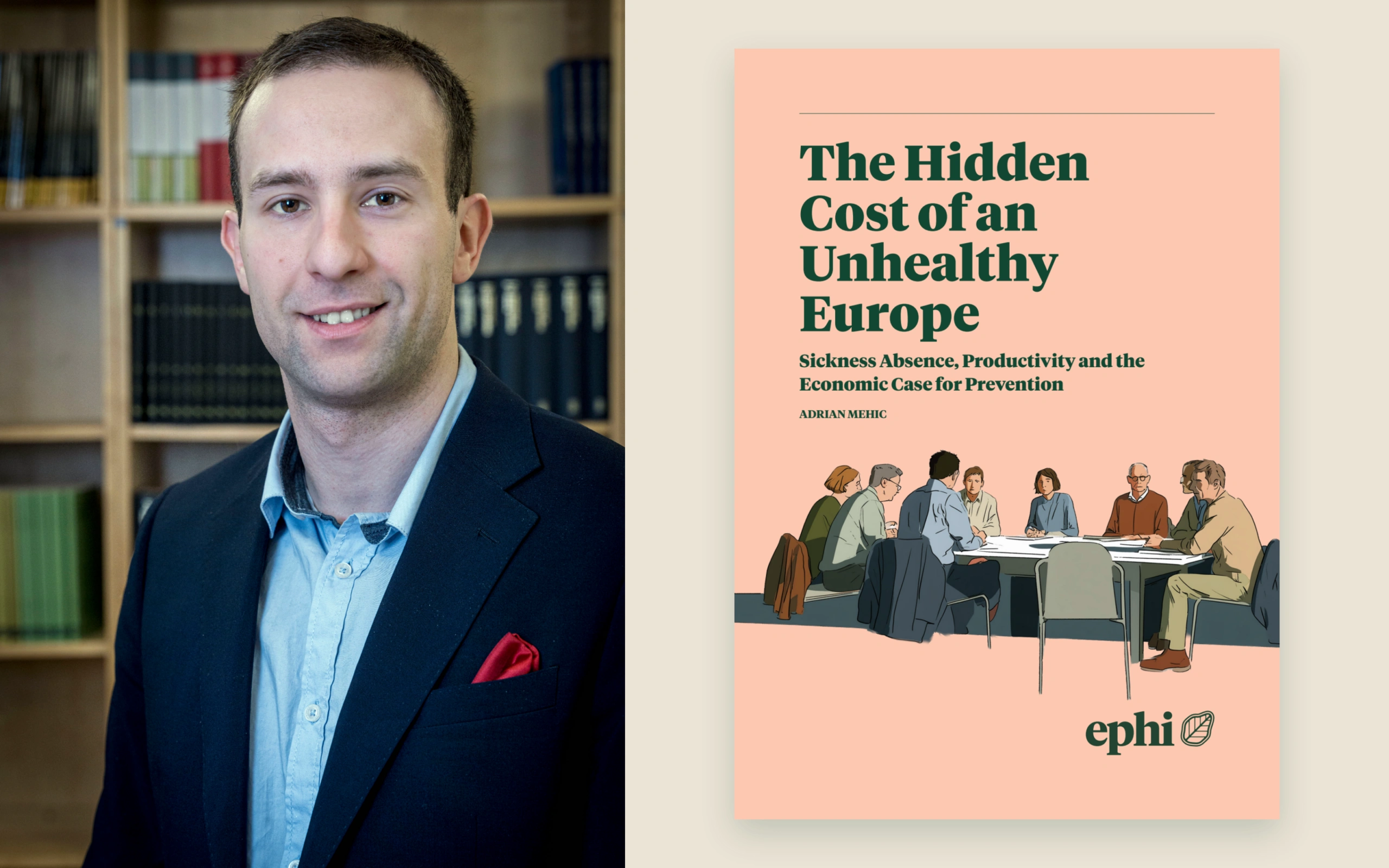
EPHI’s new report on sick leave in the EU estimates that sick leave corresponds to direct labor costs of approximately 540 billion euros per year. When estimated indirect productivity costs are factored in, the total cost amounts to 675–810 billion euros. The report was written by economist Adrian Mehic and also shows that sick leave in Sweden is higher than the EU average.
In the report The Hidden Cost of an Unhealthy Europe – Sickness Absence, Productivity and the Economic Case for Prevention Sick leave in the EU is estimated to average 2.9 work weeks per full-time employee per year. This corresponds to just under 15 workdays. In Sweden, the corresponding figure is 3.2 weeks, or about 16 workdays.
The figures are estimates of costs associated with sick leave and should not be interpreted as an exact calculation of lost GDP.
The report is available on both English language and Swedish:
Key Figures from the Report
- Sick leave in the EU averages about 2.9 work weeks—just under 15 work days—per full-time employee per year (OECD data, report pp. 5–6).
- Direct labor costs: approximately 540 billion euros per year, with a range of about 450–630 billion euros. This corresponds to roughly 2.9 percent of the EU’s GDP in 2025 (report, pp. 8–9).
- With estimated indirect productivity effects of 25–50 percent, the total cost amounts to 675–810 billion euros per year, which is on the order of 4 percent of the EU’s GDP (pp. 9–10).
- A scenario in which sick leave were to decrease by 10 percent would reduce direct costs by nearly 55 billion euros per year, and by 69–81 billion euros when indirect effects are taken into account. This is an estimate, not an observed outcome (p. 10).
- In Sweden, mental health issues accounted for 46 percent of ongoing sick leave cases in May 2026 (Swedish Social Insurance Agency, p. 8).
How does the report measure sick leave across countries?
The report uses the OECD’s comparable indicator, which is based on the EU Labor Force Survey and covers full-time employees. It includes full weeks of absence and lost hours for weeks with partial work. The OECD multiplies the observed values by two to adjust for underreporting, according to the report’s description.
How big are the differences between countries?
In the table’s sample for 2025, reported absenteeism ranges from 5.7 weeks per full-time employee in Norway to 0.2 weeks in Greece. The report emphasizes that these differences alone do not indicate how healthy the populations are: compensation systems, data collection methods, the composition of the labor market, and presenteeism can all influence the results.
What are the reasons behind sick leave?
The report highlights mental health issues and musculoskeletal disorders as major diagnostic groups. According to the report, preventive workplace health and safety measures, early treatment, and rehabilitation can potentially influence the risk of sick leave and its duration, even though not all illnesses can be prevented.
What does the estimate of 540 billion euros mean?
This figure represents the report’s estimate of the value of working hours and labor costs associated with sick leave. It is not an exact calculation of lost GDP: some work is made up for or performed by colleagues, while absences may also entail other costs.
Why might the actual cost be higher than the direct calculation?
The calculation includes absences among individuals who are still considered full-time employees and therefore does not capture the full loss of productivity when long-term illness leads to reduced working hours or someone leaving the labor market. Nor does it, in and of itself, fully account for indirect effects on coworkers, staffing, and operations.
What approach does the report advocate?
The report does not advocate eliminating all sick leave; people need to be able to stay home to recover and avoid infecting others. The focus is on reducing preventable absences and improving access to early care, rehabilitation, workplace health and safety initiatives, and coordination. Preventive measures should be evaluated, as they require resources and do not always yield good results.
Frequently Asked Questions
According to the report, how much does sick leave cost in the EU?
Direct labor costs are estimated at about 540 billion euros per year, with a range of approximately 450–630 billion euros. Including estimated indirect productivity effects, the report puts the figure at 675–810 billion euros per year.
How many workdays does sick leave in the EU amount to?
The report indicates an average of just under 15 workday equivalents per full-time employee per year in the EU, based on approximately 2.9 workweeks.
Which countries have the highest and lowest rates of sick leave in the table in the report?
In the 2025 survey, Norway ranks highest at 5.7 weeks per full-time employee, while Greece ranks lowest at 0.2 weeks. The report cautions that these differences cannot be directly interpreted as differences in the health of the populations.
Can the entire cost of sick leave be avoided?
No. The report explicitly states that not all sick leave can or should be prevented. It emphasizes that people need to stay home when they are sick and instead focuses on preventable absences and faster access to treatment and rehabilitation.
What would a 10 percent reduction in sick leave mean?
The report’s scenario estimates a reduction in direct labor costs of nearly 55 billion euros per year. Taking into account estimated multiplier effects, the reduction is estimated at approximately 69–81 billion euros per year.
Things to Keep in Mind When Using the Numbers
The report emphasizes that international comparisons of sick leave are influenced by compensation rules, data collection methods, statistical data, and the composition of the labor market. The cost figures are estimates: 540 billion euros is not an exact calculation of lost GDP, and the indirect costs are based on a simplified assumption of a 25–50 percent impact on productivity. The report also states that not all sick leave can or should be prevented and that preventive measures must be evaluated.
Related: Prevention and Longevity · EU Health Policy