

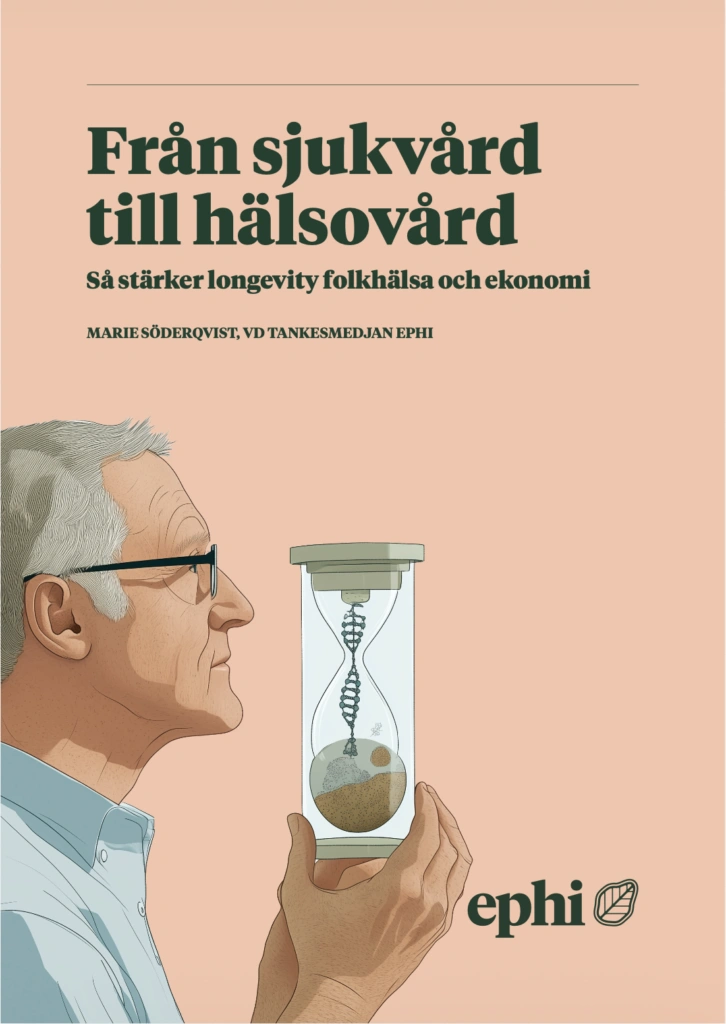
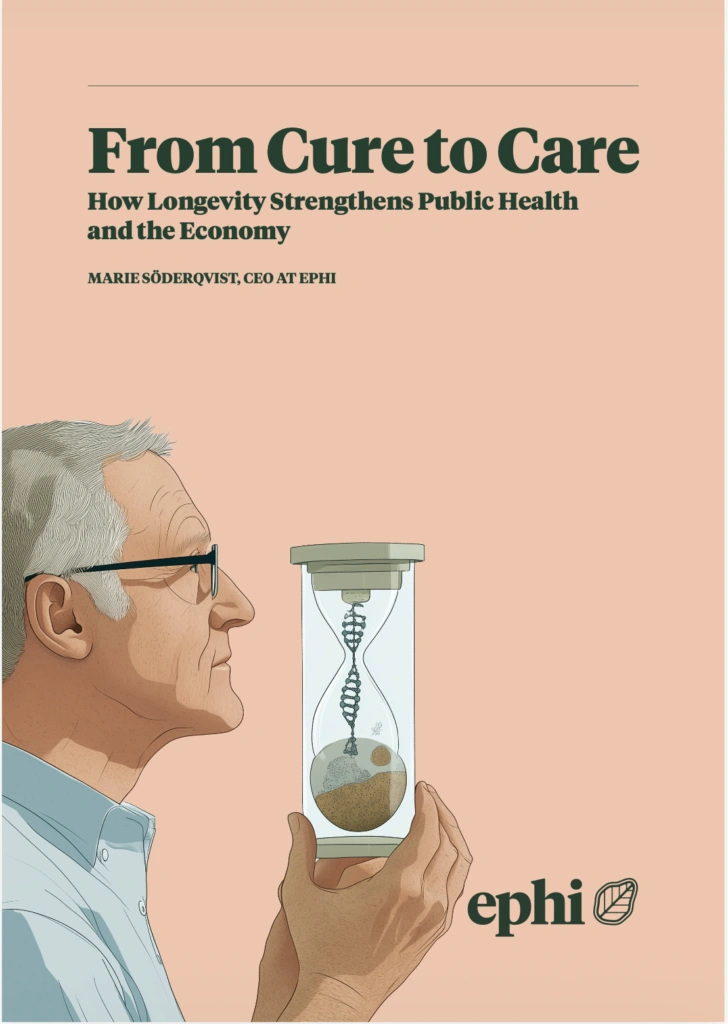
Sweden spends enormous resources on treating diseases once they have already occurred, but very little on keeping people healthy in the first place. The average Swede spends the last ten years of his or her life in poor health, and there are huge socio-economic gains to be made if we can reduce that time. In the new report From healthcare to health care EPHI CEO Marie Söderqvist explores how prevention, longevity and new health technologies could improve public health, reduce waiting lists and save billions for society.
With the report “From healthcare to health care - how longevity strengthens public health and the economy”, we propose a shift from “How do we treat disease? to ”How do we keep people healthy for as long as possible?“.
The report also highlights that private entrepreneurs, investors and healthcare actors are crucial to developing the future of healthcare and making Sweden a leading longevity nation.
The report is available on both English language and Swedish
Watch the conversation about the report
On the occasion of the report release, we collected the health profile Johannes Cullberg, Julia Elf, CEO and founder of Elfcare, Maria Rankka, Chairman of the Board of Cellcolabs and entrepreneur Douglas Roos in a discussion on the possibilities of preventive care.
About the report in Almedalen
Don't miss our seminar on the same theme in Almedalen.
11:00 at St:Hansgatan 18.
The panel consists of:
Karin Fälldin, Chairman of the Public Health and Dental Care Committee of the Primary Care Board, Region Stockholm, C
Jonas Lindberg, Regional Council, Region Stockholm, V
Magnus Elfdahl, Head of Risk and Health, Skandia
Vincent Amble-Naess , Physician and Program Manager of Health for the Unhealthy , EPHI
The report's main conclusion
Key issue: How can the Swedish healthcare system shift from primarily treating disease to focusing more on preventing it and extending people’s healthy life years?
The report argues that prevention should become a core function of the Swedish healthcare system, with a more modern regulatory framework, better incentives, new technology, and collaboration between public healthcare and private initiatives. It argues that such a shift could improve public health and free up socioeconomic resources, but several of the market and cost-saving figures presented are estimates or projections.
Key Figures
- Life expectancy is 82 years for men and 85 years for women; in 1970, the corresponding figures were 72 and 77 years, respectively. (Source: Statistics Sweden (2025c), p. 7; the chart covers 1970–2024.)
- The WHO’s estimate for 2021 puts healthy life years at 71.2 for women and 71 for men in Sweden; the report describes the difference from life expectancy as approximately 10 years of poor health. (Source: World Health Organization (2024b), p. 8.)
- In 2023, health care expenditures amounted to approximately 11 percent of GDP, equivalent to approximately 693 billion kronor. The cost of prescription drugs is not included in this figure. (Source: Statistics Sweden (2025a), p. 9.)
- On average, just over 3 percent of Sweden’s total healthcare expenditures go toward preventive care; the EU-27 average for 2018–2022 was just over 4 percent. (Source: Statistics Sweden (2025e) and Eurostat (2026), p. 9.)
- Werlab’s health screenings detected 3,589 cases of prediabetes and 3,140 cases of diabetes between 2015 and 2023. (Source: Adam et al. (2024), p. 12. The report’s reference list cites Adam et al. (2025).)
- In the Stockholm Region’s pilot project, 51 percent of the original participants had lowered their blood sugar levels to a level that no longer posed a risk for type 2 diabetes after one year. (Source: Stockholm Region (2025), p. 16.)
- Up to 80 percent of cardiovascular diseases are said to be preventable; the cost of cardiovascular diseases is estimated at approximately 60.2 billion kronor in 2019. (Source: Andersson et al. (2021), p. 15.)
- A 10 percent reduction in lifestyle-related risk factors is estimated to yield savings of over 20 billion kronor over ten years, or 2 billion kronor per year. (Source: Bolin (2024), p. 16; calculations are based on data from 2011–2021.)
- Estimates of global sales in the longevity industry vary depending on the scope of the analysis: approximately 73,000 billion kronor by 2030 under a broader definition, or about 275 billion kronor in 2025 and over 500 billion kronor in 2035 under a narrower definition focused on biotechnology. (Source: UBS Wealth Management (2025) and Research Business Insights (2026), p. 20.)
- Mounjaro’s sales increased by an average of 25% per month in 2025, from 20 million kronor in January to 154 million kronor in October; Wegovy is reported to generate approximately 230 million kronor in sales per month. (Source: Svenska Dagbladet, according to Dahlberg (2025), p. 20.)
Why does the report want to shift the focus from medical care to health care?
The report notes that people are living longer, while chronic and lifestyle-related diseases are placing a growing burden on the healthcare system. It emphasizes that preventive measures and early detection can contribute to more healthy years of life and reduce future healthcare needs.
How are life expectancy and healthy life years changing in Sweden?
Life expectancy has increased, but the report distinguishes it from healthy life years. According to WHO data for 2021, life expectancy in good health was 71.2 years for women and 71 years for men; the report also states that the increase in healthy life years has leveled off in recent years and has been affected by the COVID-19 pandemic.
What percentage of healthcare resources is allocated to prevention?
The report states that health care expenditures in 2023 accounted for approximately 11 percent of GDP, or about 693 billion kronor, excluding the cost of medications. On average, just over 3 percent of total healthcare expenditures are allocated to preventive care; during the pandemic, that share rose to just over 4 percent, but the report describes the increase as temporary.
What examples of preventive measures does the report discuss?
Among other things, the report describes health screenings conducted by Werlabs, cancer screening, and two regional health bond projects. In the Stockholm Region, over 900 people at high risk for type 2 diabetes participated in a five-year initiative offering support in the areas of diet, exercise, sleep, and stress; in Uppsala, plans were made to screen 15,000 people for high blood pressure.
What economic effects of prevention are reported?
The report cites several estimates from external studies and reports. For example, according to Bolin (2024), a 10 percent reduction in lifestyle-related risk factors is estimated to yield savings of over 20 billion kronor over ten years; this is an estimate, not a confirmed outcome.
According to the report, what is needed for Sweden to develop a longevity industry?
The report highlights Sweden’s research expertise, life sciences industry, and demand for health services as key factors. At the same time, it argues for a more modern regulatory framework and incentives that facilitate private investment and innovation, as well as collaboration between the private and public sectors.
Frequently Asked Questions
How much does Sweden spend on health care?
The report estimates approximately 693 billion kronor in 2023, equivalent to about 11 percent of GDP. Pharmaceutical costs are not included in this total.
What percentage of healthcare spending in Sweden goes toward preventive care?
On average, just over 3 percent, according to the report’s reference to Statistics Sweden (SCB). The percentage temporarily rose to just over 4 percent during the COVID-19 pandemic.
How many healthy years of life do women and men in Sweden have?
The WHO's estimate for 2021, as reported in the report, is 71.2 years for women and 71 years for men.
What results are being reported from the health bond in the Stockholm Region?
One year into the pilot project, 51 percent of the original participants had lowered their blood sugar levels to a point where they were no longer at risk for type 2 diabetes. The report also states that Skandia received a full financial refund once the project was completed.
How large could the longevity market become?
The report presents various estimates depending on how the market is defined: approximately 73,000 billion kronor in global sales by 2030 under a broad definition, and approximately 275 billion kronor by 2025 for a more narrowly defined biotechnology market.
Things to Keep in Mind When Using the Numbers
The report states that healthy life years and market size are based on estimates and that the value of the longevity market varies depending on the definition. Healthcare expenditures of approximately 693 billion kronor exclude the cost of medications. The economic savings reported are estimates, not generally guaranteed outcomes. The information regarding Werlabs is cited in the main text as Adam et al. (2024), while the reference list lists Adam et al. (2025).
Related: Prevention and Longevity