
The WHO wants to limit contact between politicians and companies in the alcohol and food sectors, just as has already been done with the tobacco industry. Does this protect decision-making from undue influence, or does it risk excluding large parts of the business community from the democratic process?
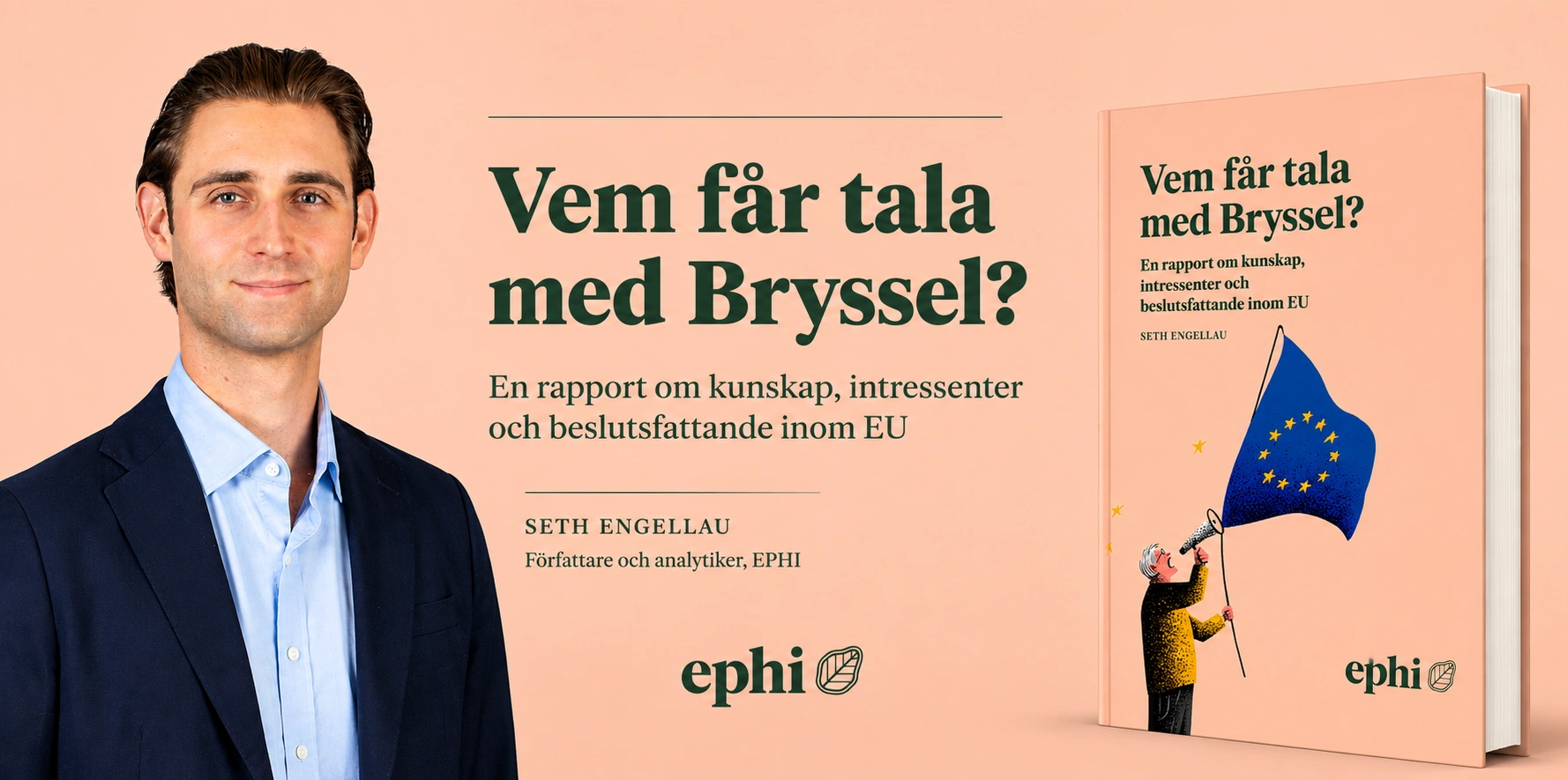
In EPHI’s latest report, *Who Gets to Speak to Brussels*, the author, Seth Engellau, examines how limited access to decision-makers affects the quality of the decisions made in Brussels.
The report is available on both English language and Swedish
About the report in Almedalen
Don’t miss our seminar on the report at Almedalen.
Date and time: Thursday, June 25, at 1:00 p.m.
Address: S:t Hansgatan 47, Visby (Gotlands Bryggeri courtyard)
Guests: Anders Lindberg, political editor-in-chief at Aftonbladet, Joar Forssell, a member of the Riksdag for the Liberal Party,
Katja Werner, Public Affairs & Communications at the Swedish Brewers Association and Lars Appelqvist, CEO of Scan Sweden.
The discussion will be moderated by Marie Söderqvist and Henrik Jönsson
The report's main conclusion
Key issue: How does stakeholders’ access to EU decision-makers affect the quality of decision-making processes, particularly in the tobacco, food, and alcohol sectors?
The report argues that severely limited contact between EU policymakers and relevant stakeholders risks undermining the basis for decision-making, policy outcomes, and implementation. It concludes that transparent and regulated channels of communication are needed to ensure that different perspectives and sector-specific knowledge can be taken into account.
Key Figures
- In 2022, 26.5 percent of the EU’s adult population used tobacco, compared with the global average of 20.9 percent. (Source: WHO (2025), reference 6; page 10 of the report.)
- Excise tax revenue from tobacco amounted to approximately 82.3 billion euros in 2017, according to the body of the report. (Source: European Commission (2020a), reference 7; page 10 of the report. The reference cited here, however, specifies 2016.)
- The tobacco sector accounted for over 1.5 million jobs in the EU-27. (Source: Tobacco Europe (2021), reference 8; page 10 of the report.)
- The food industry is reported to have a turnover of 1.2 trillion euros and 4.7 million jobs in the EU. (Source: FoodDrinkEurope (2024), reference 13; page 11 of the report.)
- The EU exported alcoholic beverages worth approximately 29.8 billion euros in 2024. (Source: Eurostat (2025), reference 18; page 13 of the report.)
- In 2022, the wine sector contributed approximately 130 billion euros to the EU’s GDP, equivalent to about 0.8 percent of the European economy, and generated approximately 2.9 million jobs within the EU. (Source: EU Wine Market Observatory (2024), reference 19; page 13 of the report.)
What does the report on stakeholders' access to the EU examine?
The report analyzes how a stricter application of the WHO guidelines can limit contact between EU policymakers and stakeholders in the tobacco, food, and alcohol industries. It focuses on how access to knowledge, information, and experiences from relevant stakeholders can influence the quality of the decision-making process.
Why does the report believe that stakeholder dialogue can provide insights?
Based on Friedrich Hayek’s view of knowledge, the report describes relevant information and experience as being dispersed among many people and organizations. Decision-makers may therefore overlook sector-specific knowledge if their contact with relevant stakeholders is limited.
What does the case study on tobacco show?
The report describes how contacts between EU institutions and tobacco-related stakeholders were restricted following the “Dalligate” scandal and a stricter interpretation of the WHO Framework Convention on Tobacco Control. It also emphasizes that tobacco products are not homogeneous and that differences between products may be relevant to public health.
What questions were raised about Nutri-Score?
The report describes criticism of the consultations on Nutri-Score, including from member states, agricultural producers, food companies, and nutrition experts. The criticism focused, among other things, on methodological assumptions, comparisons between product categories, and how dietary patterns and traditions were taken into account; the report states that the Commission subsequently paused implementation.
What does the report say about alcohol warnings in Ireland?
The report uses Ireland’s mandatory health warnings on alcohol packaging as a case study. It describes objections regarding limited access to policymakers and the design of the warnings, and states that implementation was recently put on hold and appeared to be in the process of being withdrawn.
What conclusion does the report draw regarding regulated contact surfaces?
The report concludes that transparent and regulated engagement can provide decision-makers with the opportunity to gain insight into different perspectives and relevant practical knowledge. It emphasizes that this does not mean that a single stakeholder should dictate decisions, but rather that it must be possible to strike a balance between competing interests.
Frequently Asked Questions
What is the report *Who Gets to Talk to Brussels?* about?
It analyzes how stakeholders' access to EU decision-makers can influence decision-making processes in the tobacco, food, and alcohol sectors.
Who wrote the report?
The report was written by Seth Engellau.
What does the report mean by “stakeholder”?
A stakeholder is defined as a person or group that is involved in or affected by a decision or action. The report also notes that stakeholders may have specialized knowledge and experience in the field.
Which three sectors are covered in the report's case studies?
Tobacco, food, and alcohol.
Does the report advocate a specific policy for these sectors?
No. The report states that its purpose is not to advocate for a particular policy, regulatory framework, or specific policy outcomes, but rather to highlight how limited access can affect the interplay between decision-making, knowledge, and information.
Things to Keep in Mind When Using the Numbers
The report states that it does not advocate any particular policy, regulatory framework, or specific policy outcomes. Several conclusions are presented as risks or possible consequences. The figure for tobacco excise tax revenue is stated in the body of the text as approximately 82.3 billion euros in 2017, while the source cited in the report refers to revenue for 2016.
Related: EU Health Policy · Nicotine, Snus, and Harm Reduction